
Steel products are highly impact-resistant and durable during transportation. But harsh conditions, such as marine shipping, can cause saltwater exposure and corrosion of steel products. Even brand-new steel products may experience high stress and damage during shipping.
To avoid these issues during shipping, proper bundling and seaworthy packaging are essential. Today, we will discuss how to package steel pipes and ensure safe transport.
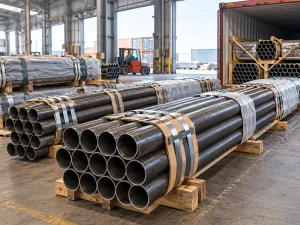
Why Steel Pipes Are Vulnerable During Ocean Transportation
Unlike many industrial products, steel products are especially vulnerable during ocean transportation. First, they are shipped in large quantities throughout the journey. Moreover, there is exposure to high-risk factors, such as:
- Salt spray exposure
- High humidity inside containers
- Cargo condensation
- Bundle shifting during rough seas
- Crane and forklift impact
- Metal-to-metal contact
- Improper lifting practices
- Pipe-end crushing
- Surface scratching
- Bending or ovality deformation
These factors can damage steel products, affect corrosion performance, and even deform steel pipes. Therefore, packaging and bundling of the steel products is crucial.
Practice #1: Anti-Rust Oil Coating: The First Line of Defence
Anti-rust oil coating protects against corrosion. Steel surfaces can develop corrosion when exposed to moisture, oxygen, and salt contamination.
Benefits of Anti-Rust Coating
- Block moisture contact and reduce the chances of corrosion
- Reduce oxidation of the steel products
- Protect bare steel surfaces
- Minimise flash rust formation
- Preserve surface appearance
Best Practices
When applying the anti-rust oil layer, follow the practices below.
- Apply coating after final inspection.
- Ensure surfaces are clean and dry.
- Cover the entire exposed surface.
- Reinspect the coating before loading.
- Use export-grade corrosion inhibitors.
Practice #2: Plastic Pipe Caps Protect Critical Pipe Ends
Plastic pipe caps protect the steel ends. They are critical components for protecting stainless steel pipes.
Why are plastic pipe caps essential?
Plastic pipe caps protect and offer the following benefits and functions.
- Impact protection helps reduce damage during handling.
- Shape retention prevents pipe-end deformation
- The moisture barrier limits water entry.
- Dirt prevention helps keep pipe interiors clean.
- Bevel protection protects the welding surfaces.
Practice #3: High-Strength Steel Strapping Keeps Bundles Stable
Bundling is crucial and a critical safety step for shipping stainless steel products. It provides seamless safety in ocean shipping.
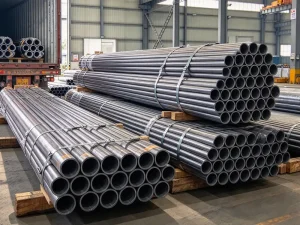
Effects of Ignoring Bundling
Ignoring bundling can affect the shipping quality of the steel products. The effects may include:
- Shift inside the container
- Roll during vessel movement
- Strike adjacent bundles
- Develop dents and scratches
- Experience pipe-end damage
Function of Steel Strapping
Steel strapping is an ideal solution that makes shipping easier throughout the journey. The functions of steel strapping include:
- Holds pipes tightly together
- Reduces vibration damage
- Prevents bundle separation
- Improves lifting stability
- Minimizes cargo shifting
Bundling Tips
When bundling the steel pipes, you should carefully evaluate the quantities, strapping methods, and bundle weight. For correct bundling, experts tip include:
- Use multiple strap locations along bundle length.
- Maintain uniform bundle dimensions.
- Avoid excessive bundle weight.
- Inspect strap tension before shipment.
- Replace damaged straps immediately.
Practice #4: Wooden Dunnage and Spacers Prevent Contact Damage
When steel pipes are placed together, they may rub against each other. This causes surface scratches, affects the overall appearance, and may damage the steel components.
Wooden dunnage separates steel materials and improves shipping safety. This prevents contact between different steel parts and keeps steel components safe.
Practice #5: Moisture Control During Ocean Shipping
Corrosion is one of the most significant issues during ocean shipping. However, it is not the direct effect of ocean water, but moisture condensation inside the containers.
It can cause corrosion and may affect the steel pipe’s performance.
Moisture Prevention Checklist
To avoid moisture corrosion, you should follow the best practices as follows:
- Apply anti-rust oil.
- Use waterproof packaging materials.
- Install desiccants.
- Seal exposed openings.
- Inspect container condition before loading.
Practice #6: Container Loading and Cargo Securing
Even the best packaging and securing strategy may not protect stainless steel pipes unless they are rated for secure loading. For loading, consider different conditions, such as vessel rolling, height, container sizes, and exact loading.
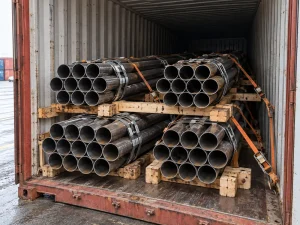
Proper Cargo Securing Measures
For cargo securing, consider these measures.
- Blocking provides stability and reduces movement.
- Bracing elevates the stability of cargo.
- Lashing helps secure cargo position.
- Dunnage placement effectively distributes weight.
- Anti-slip materials reduce sliding.
Practice #7: Container Shipping vs Breakbulk Shipping
Which transportation method do you want to use? Container shipping differs from breakbulk shipping.
Container Shipping
Container shipping accommodates the steel pipes within containers and provides better protection. It is weatherproof, reduces exposure to saltwater conditions, and creates a less challenging environment for stainless steel systems.
Breakbulk Shipping
Here comes the breakbulk shipping process. It uses intermodal containers and is suitable for shipping long stainless steel pipes. You should select this packaging mode for the large project cargo systems.
Practice #8: Pre-Shipment Inspection: Verifying Packaging Quality
After selecting the packaging, conduct a pre-shipment analysis. The purpose of this analysis is to verify if your packages have the same quality and integrity for the given shipping conditions.
Packaging Verification
During the packaging inspection process, you must verify the compatibility of your packages with:
- Anti-rust coating condition
- Pipe cap installation
- Bundle dimensions
- Strap tension
- Dunnage placement
- Label accuracy
Loading Verification
Container Loading may also cause deformation and stress. For loading, you should verify:
- Container condition
- Cargo securing methods
- Weight distribution
- Lashing quality
- Moisture protection measures
Conclusión
Trans-Pacific steel shipping exposes steel products to stress conditions such as corrosion, impact damage, cargo shifting, and pipe-end deformation. Because of heavy saltwater conditions and high water pressure, improper packaging can damage steel components. For safe transport, you should consider anti-rust oil coating, plastic pipe caps, high-strength steel strapping, wooden dunnage, and moisture protection.
If you are looking for ACRS- and MTC-certified steel products with high resistance to impact and corrosion, look no further. UNIASEN is already leading the market. We develop high-end steel products. We ensure seamless cross-border supply and provide detailed verification certificates. Contact our experts right away!